Evaluating Study Planner KDP: Format, Features, and Practical Fit for Self-Publishers
Selecting the right interior template is often the most critical technical decision when creating low-content books for Amazon KDP. For creators focusing on academic or self-directed learning niches, the Study Planner KDP format offers a specific structural approach that differs significantly from generic journals or standard calendars. Understanding the distinct characteristics of this 8.5x11 no-bleed layout is essential for determining whether it aligns with your publishing goals and audience needs. This evaluation breaks down the functional design, market positioning, and practical tradeoffs associated with this specific planner type to help you make an informed resource selection.
Defining the Study Planner KDP Specification
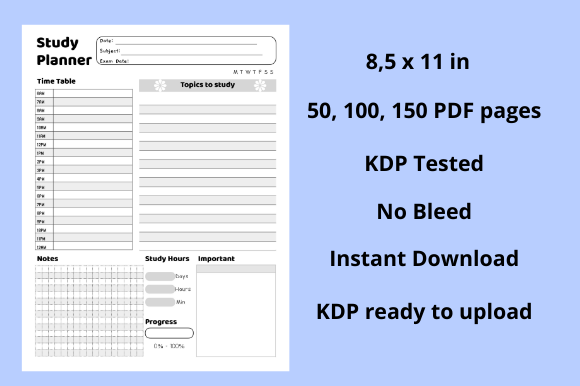
The term "Study Planner KDP" in this context refers to a precise set of technical and functional parameters designed for print-on-demand efficiency and user utility. Unlike open-ended notebooks, this template is engineered with a fixed architecture optimized for tracking academic progress. The standard specification involves an 8.5x11 inch trim size with no bleed, which maximizes the printable area while maintaining safe margins for binding. This size is particularly relevant for adult learners and university students who require ample space for detailed scheduling without the bulk of larger formats.
A key differentiator of this specific resource is its modular availability. Rather than offering a single static product, this study planner interior is typically structured into three distinct volume options: 50 pages, 100 pages, and 150 pages. All variations are contained within a single original PDF file, allowing publishers to select the appropriate page count based on their target semester length or course intensity. The visual design utilizes a grayscale color scheme, which is not merely an aesthetic choice but a cost-saving measure that keeps printing expenses low while maintaining high contrast for readability.
Core Functional Elements and Layout Logic
The efficacy of any study planner depends entirely on the relevance of its internal fields. This specific KDP-tested template integrates several non-negotiable elements that distinguish it from basic lined paper or dot grid journals:
- Structured Time Tables: Dedicated sections for hourly breakdowns allow users to map out study blocks rather than just listing tasks.
- Topic Tracking: Specific fields for "Topics to Study" ensure that time allocation is directly linked to curriculum content.
- Date and Week Integration: Boxes for weeks and days provide temporal context without enforcing a specific calendar year, making the planner undated and evergreen.
- Square Grid for Notes: A versatile section that accommodates diagrams, mind maps, or brief summaries alongside schedule data.
- Quantitative Metrics: Fields for "Study Hours" and "Progress" enable users to track effort versus output, facilitating data-driven adjustments to their routine.
- Priority Flagging: An "Important" designation helps users triage tasks within a dense academic workload.
This combination transforms the book from a passive recording device into an active management tool. When evaluating this against other options, consider whether your audience requires this level of granular tracking or if they prefer unstructured space.
Comparative Analysis: Specialized vs. Generic Interiors
When researching alternatives, you will likely encounter three primary categories: generic composition notebooks, dated academic planners, and digital productivity apps. Each presents distinct advantages and limitations compared to the Study Planner KDP format.
Versus Generic Notebooks and Journals
Standard lined or dot-grid journals offer maximum flexibility but zero guidance. While suitable for creative note-taking, they often fail as study tools because they lack pre-defined prompts for time management and progress tracking. Users must draw their own tables and trackers, which adds friction to the study process. The Study Planner KDP removes this friction by providing a consistent framework. However, the tradeoff is rigidity; if a student’s workflow does not match the provided fields, the unused space becomes wasted paper. Generic notebooks are superior only when the user’s needs are highly idiosyncratic or constantly changing.
Versus Dated Commercial Planners
Traditional bookstore planners come with pre-printed dates and holidays. While convenient, this creates significant inventory risk for KDP publishers and limits the product's shelf life. An undated Study Planner KDP remains sellable year-round and can be marketed for summer sessions, gap years, or professional certification prep that does not follow a traditional academic calendar. The downside is that users must manually fill in dates, which some find tedious. If your target audience values immediate usability over longevity and flexibility, a dated alternative may be preferable despite the higher production complexity.
Versus Digital Planning Tools
Digital apps excel at automation, reminders, and cross-device syncing. They cannot, however, replicate the cognitive benefits of analog planning. Research suggests that handwriting schedules and tracking progress physically can improve retention and reduce digital distraction. The physical Study Planner KDP serves as a dedicated, offline focus tool. It is best positioned not as a replacement for digital tools, but as a complementary resource for deep work sessions where screen fatigue is a concern. Publishers should frame this distinction clearly in their listings to attract buyers seeking intentional disconnection.
Strategic Considerations for Page Count Selection
The availability of 50, 100, and 150-page variants within a single source file addresses a common pain point in low-content publishing: matching product thickness to perceived value and practical use cases. Selecting the wrong page count can negatively impact reviews and sales velocity.
The 50-Page Variant: This thin format is ideal for short-term intensive courses, exam prep sprints, or as a supplementary tracker. Its lower price point makes it an accessible entry product. However, it may feel insubstantial as a primary semester planner. Best fit: Certification study guides, summer workshops, or habit formation trials.
The 100-Page Variant: Often the industry standard for single-semester academic planners. It provides sufficient depth for a 12-16 week term plus introductory and review pages. This balance of portability and capacity makes it the safest default choice for general university audiences. Best fit: Standard college semesters, quarterly professional development cycles.
The 150-Page Variant: Designed for comprehensive tracking across longer periods or for heavy-course-load students. The increased spine width also allows for more visible text on the cover, which can improve discoverability in search results. The tradeoff is higher printing costs and reduced portability. Best fit: Full academic years, medical/law school programs, or users who combine multiple subjects in one volume.
Technical Advantages of the No-Bleed Grayscale Format
From a production standpoint, the no-bleed grayscale specification of this Study Planner KDP offers tangible benefits that influence profitability and quality control. Bleed interiors require extending artwork beyond the trim line, which increases the risk of misalignment during printing and necessitates larger file sizes. By utilizing a no-bleed design with safe margins, you minimize rejection risks and simplify the upload process.
Grayscale printing is significantly less expensive than color on KDP. For a functional tool like a study planner, color rarely adds utility; high-contrast gray tones are sufficient for distinguishing headers, grids, and writing spaces. These savings can be passed to consumers through competitive pricing or retained as higher royalties. When comparing resources, always calculate the break-even point; a color interior might look more attractive in mockups but could require a 30-40% price premium that suppresses conversion rates in the student demographic.
Identifying Limitations and Decision Factors
No single template serves every publisher or end-user. Recognizing when not to use this Study Planner KDP is as important as understanding its strengths.
Customization Constraints: Because this is a pre-formatted PDF, you cannot easily alter field labels or rearrange sections without graphic design software and significant rework. If your niche requires specialized terminology (e.g., "Clinical Rotation Hours" instead of "Study Hours"), a fully customizable Canva or InDesign template may be worth the additional setup time.
Market Saturation: General study planners are a competitive category. Success with this template depends heavily on external differentiation: unique cover design, targeted keyword research, and compelling listing copy that speaks to a specific sub-niche. Simply uploading the interior without strategic positioning is unlikely to yield sustainable results.
Audience Mismatch: This layout assumes a structured, metrics-oriented approach to learning. It is less suitable for creative arts students, reflective journalers, or those following unschooling methodologies. Always validate that your target audience values quantitative tracking before committing to this format.
Making the Final Evaluation
The decision to utilize this Study Planner KDP resource should stem from a clear alignment between its fixed features and your audience’s documented needs. It excels as a cost-effective, technically reliable foundation for academic and professional development niches where structure drives outcomes. Its modular page counts and no-bleed grayscale design address practical publishing constraints effectively.
However, treat it as one option within a broader ecosystem. Compare it against your specific requirements for customization, audience expectations for guidance versus freedom, and financial targets for royalty margins. Test different page counts if uncertain; the single-file delivery makes experimentation relatively low-risk. Ultimately, the most successful KDP products are those where the interior format feels invisible to the user because it so perfectly supports their intended workflow. Use this evaluation framework to determine if this particular study planner achieves that alignment for your publishing portfolio.